Download the App Your Meditation Companion
Start

Painted in Silence: Icon Painting as a Form of Prayer

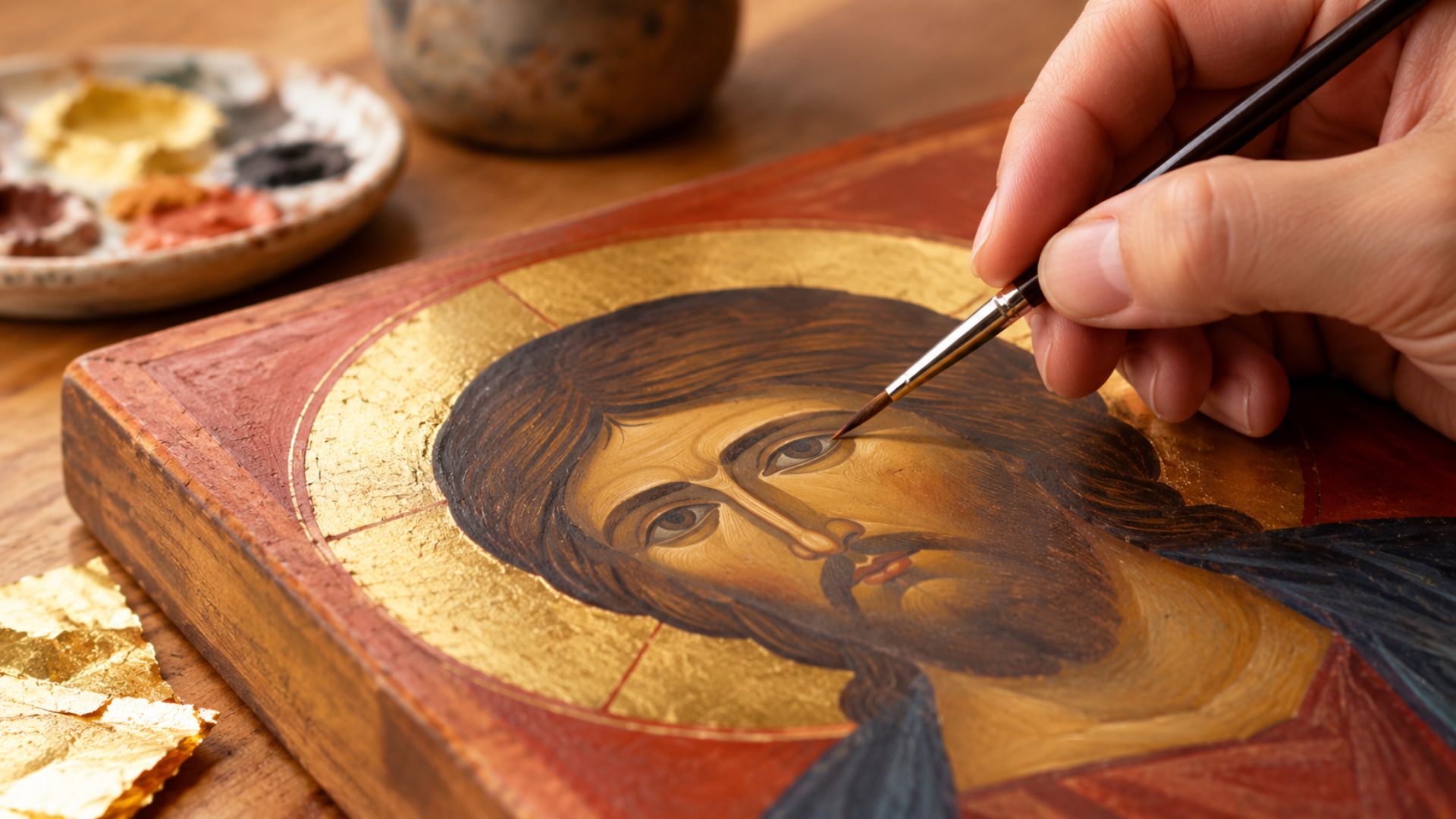
Icon Painting ChatGPT Generated

This article is a transcription of an interview between Hanna-Leena Ward, Finnish-born iconographer and Paola, WCCM Marketing & Comms.

You describe your icon painting as a form of prayer where your hand is guided from above, rather than art made purely for exhibition. How does the physical act of creation shape your own inner contemplative life?

Icon painting has been part of my whole life. Icons are painted for prayer and are painted in prayer, therefore the painting needs to happen in silence.

For example, when I am painting I need to be on my own, completely focused on what I am painting. If I’m not completely focused, the outcome will be different. When it comes to icon painting, I would say that even though icons are historically mainly from the Orthodox tradition, many faith traditions, Catholics, Anglicans, Lutherans, have gradually been adopting icons and icons are becoming more integrated in the liturgy. 

There is an underlying need for that silence when painting icons. Silence allows us to connect to God, I believe that what we are painting becomes the window to the other side. It is so deep and that connection is so important.


When we paint icons, we follow very specific canons, we are not painting icons for our own creativity. Icon painting is not a boost of our own egos - a reason why icons are never signed - because we're not painting them for ourselves really. We're painting them for liturgy and for prayer.
Hanna Leena-Ward
Iconographer

Having studied under master iconographers and traveled everywhere from Bethlehem to Finland to learn ancient techniques, what do you find most essential about passing these nearly 2,000-year-old traditions on to contemporary students of all levels?

It is a real honour to be able to teach this old tradition of iconography which has been destroyed in so many countries over the years. I believe it is really our duty to pass this tradition on to the next generations. 

Plus, there aren’t that many teachers, and even fewer female teachers. This used to be a tradition carried out by monks, and few nuns, in monasteries. 

I personally get so much out of icon painting and I am very grateful to be able to share this tradition with everyone. I would also say that we paint with joy. Because all faiths are ultimately searching for beauty and God’s beauty, to be able to paint icons, is a form of search for beauty and joy. In my classes, I always encourage my students to paint with joy.

Iconography is a prayer and my hand is guided from above. Icons are not painted for exhibitions; they are for private prayer, but it is my duty to exhibit them, and to talk to people about them, because people don’t see them enough.
Hanna Leena-Ward
Iconographer
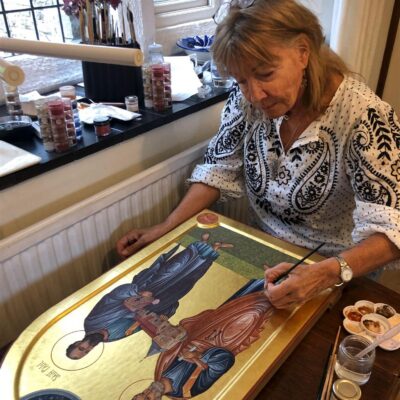
And I guess there is something quite unique about painting as part of a group together, as part of a journey like a retreat, one's sharing this path step by step, it's a bit of a journey with yourself and with with others? 

Yes, that’s why experiencing icon painting at a retreat is wonderful, a retreat is a complete experience: you live, you sleep, you breathe and you are in prayers together. Compared to classes where at the end of it, you go back to your home, your routine life, in a retreat you can continue that immersive experience and you can live that experience much more powerfully. 

I felt that strong powerful experience when I painted my first icon years ago, I know how it can change your life. I often tell my students how icon painting can transform your life, change your life, you’ll never be the way you were when you started it. 

Icon painting is like art therapy, but with faith thus even more powerful. I hope my students during my icon painting course at Bonnevaux will enjoy it there with me. 

Lots of artists come to me and they think that they can paint icons very easily, however as we are painting from darkness to light, it is a completely different experience to normal painting. The initial stage is what I would define as ‘the chaos stage’ -same as in our life –  we start with chaos – from darker colors – we’re trying to bring order into our icons, onto that chaos. And then as we start adding layers, lighter and lighter colors, it is as if we are in a search of light. Figuratively, it is very theological, from initial darkness in a journey to search for the light. 

Hanna will be leading a course on traditional Byzantine Icon Painting at Bonnevaux retreat centre from 20 to 28 February, 2027.
 
During the course, students will learn the use of clay and gold leaf for gilding, painting with egg tempera, working with natural and semi-precious pigments & the techniques and spiritual meanings behind traditional Byzantine iconography.

Top Image: Icon Painting ChatGPT Generated

  • Related Posts
Scroll to Top