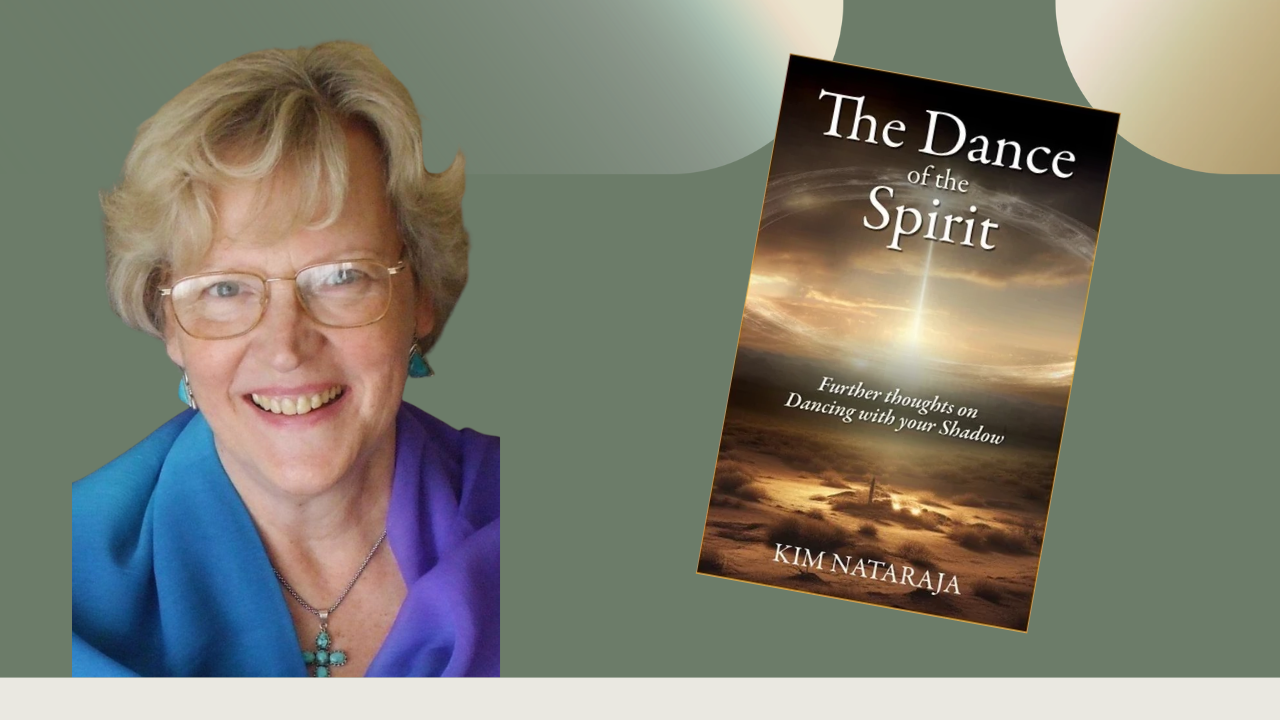
How can meditation help us move beyond the wounds of the ego, discover our true selves and rediscover meaning in a troubled world? In this conversation, Laurence Freeman speaks with Kim Nataraja, the first Director of the WCCM School of Meditation, about her new book, The Dance of the Spirit. Reflecting on her remarkable spiritual journey, her lifelong experience of meditation and her work guiding others, Kim explores the relationship between contemplation and action, the healing power of silence and the interconnectedness of all life.
Laurence Freeman: Your first book was called Dancing with Your Shadow, and now you have written The Dance of the Spirit. Are you a dancer?
Kim Nataraja: No, I’m not! And the title of the new book isn’t even mine. It came from our grandson, who was only 13 at the time. He asked me what I was writing, and I told him I was working on a new book that took into account how different the world had become since Dancing with Your Shadow.
I said I was thinking of calling it There’s Only the Dance. He wasn’t impressed! So I asked him what he would call it. He thought for a moment and said, The Dance of the Spirit.
And that’s a 13-year-old who has been meditating!
Laurence: How did a Dutch girl end up in London, eventually becoming a spiritual teacher and writer?
Kim: My parents sent me to England for six months to improve my English. They had decided I should become a simultaneous interpreter, although I wanted to study medicine. In those days, they didn’t think medicine was a suitable profession for a girl.
I attended a language school in London, where I met a friend who invited me to a party. There, I was introduced to Shankar, who would become my husband.
He told me he could read palms, and later offered to do my horoscope. That was how he managed to arrange our first date! We went to an Indian restaurant, became great friends, and eventually married.
Only three years later did I discover that he had copied my horoscope from a book on his shelf!
I went on to study French and German at Birkbeck College and became a lecturer in further education. I loved teaching there. I called it the “college of the second chance”, because many of the students hadn’t succeeded through the conventional educational system.
Laurence: Were you already aware of life as a spiritual journey during those early years?
Kim: Yes, although I didn’t have the language to describe it.
My father was Catholic and my mother belonged to the Dutch Reformed Church. Religion wasn’t discussed at home because my parents wanted to avoid disagreements.
When I was about seven or eight, I used to pass a lovely little church called the Little Dove. Something about it drew me inside. I would sit quietly at the back and repeat the Lord’s Prayer, which my maternal grandfather had taught me.
One day, as I was sitting there, everything became deeply silent, and I felt love.
I continued doing this quietly throughout my life. Even after I married, I would get up before Shankar and sit in silence, repeating a phrase from the prayer.
Eventually, he asked what I was doing. When I explained, he said, “What you’re doing is meditation. We do that in India. It’s quite normal.”
So I had been meditating for years without knowing what to call it.
Laurence: How did you eventually discover the Christian meditation community?
Kim: Once again, it happened through a series of unexpected encounters.
Our daughter asked why we weren’t attending her church. We went to speak with the vicar, Father Ian Robson, explaining our different religious backgrounds. Shankar’s father was Hindu and his mother was Anglican.
Father Ian was wonderfully welcoming. He said there was truth in all religions and that we were very welcome.
Later, he organised a week of guided prayer. I was assigned to an Irish nun, Sister Mary Moylan, and wondered how she would react when I told her how I prayed.
To my surprise, she said, “Oh, wonderful!”
When I explained that I felt rather lonely because I didn’t know anyone else who prayed this way, she told me that she did too. She directed me to the Christian Meditation Centre in London.
I gathered my courage and knocked on the door. Eileen Byrne welcomed me, gave me coffee, showed me the books and invited me to the weekly meditation group.
That’s how I found the community.
Laurence: What did you feel when you attended that first meditation group?
Kim: I felt I was at home.
I was quite shy in those days, and it took courage to go to that first meeting. But the group was small, and everyone was wonderfully welcoming.
For the first time, I wasn’t the odd one out, doing something nobody else seemed to understand.
I felt completely accepted for who I was. Nobody questioned my background or where I had come from.
It was a wonderful feeling, and that’s why I’m still part of the community today.
Laurence: You have guided and mentored many people on their spiritual journeys. How did that work begin?
Kim: Sister Mary Moylan encouraged me to become a spiritual director. She recommended a three-year course in London, and Father Ian helped arrange support for my training.
By then, I had already started a small meditation group at our church. People began asking questions and seeking guidance, and gradually the work developed.
It wasn’t something I had planned. It seemed to happen naturally, as one thing led to another.
Laurence: You became the first Director of the WCCM School of Meditation. How did that come about?
Kim: It began with conversations about what the growing community needed.
I had a background in teaching, so I understood the importance of having good resources and a structured approach to learning.
I listened to the talks given when the School was founded in Italy and considered what would be most helpful to meditators. I began developing resources to introduce people to the Christian contemplative tradition.
After three or four months, I came back with my ideas, and you told me I had the job!
I said, “No, I’ve just taken early retirement. I don’t want a job!”
Eventually, I agreed to do it for one year.
That turned into a rather long year!
One of the results was the weekly teaching programme, with a one-page reflection each week, covering five years of the Christian contemplative tradition.
Of course, all of this was possible thanks to the teaching of John Main and your books, which gave me the foundation for the work.
Laurence: Your first book, Dancing with Your Shadow, explored the relationship between the ego and the true self. What inspired you to write The Dance of the Spirit?
Kim: The world has changed enormously since I wrote Dancing with Your Shadow.
That book focused more on the individual journey: recognising our psychological wounds, understanding the ego and discovering that there is more to us than our conditioned personality.
But in the troubled world we live in today, particularly since COVID, I felt I needed to go further.
We are not just doing beings. There is another dimension to us: our being.
I wanted to explore the movement from doing to being. But when our being is grounded in spiritual silence, it leads us back to doing, because we discover our interconnectedness with other people, with nature and with ultimate reality, whatever name we give it.
That’s why I see it as a dance.
Our outer reality and ultimate reality are connected. The dance includes the ego, the true self and our spiritual being, the Christ within.
These different dimensions are not separate. They belong together.
Laurence: How can contemplation and action become one?
Kim: When we touch the silence and peace of the Christ within, we realise that we are not separate individuals.
If I have the Christ within, so does everybody else, whether they recognise it or not.
That awareness naturally encourages us to reach out to others with compassion and love.
It extends to nature, the environment and everything around us.
When we encounter someone who is struggling, we begin to see that they may be acting out of wounds that have not yet healed. Instead of judging them, we can offer understanding and compassion.
And often we recognise something of our own struggles in theirs.
I don’t see contemplation as an individual achievement, as though we could say, “Oh, I’m enlightened, hooray!”
True contemplation reaches out towards others. It becomes compassion in action.
Laurence: John Main taught that community comes into being when we learn to recognise Christ in each person. What does that mean to you?
Kim: I often tell a story that illustrates this beautifully.
I was leading a retreat in Florida on the question “Who am I?” Participants were working in pairs, asking each other that question and responding with just one or two words.
Some eventually reached the point of saying, “I am a child of Christ.”
Afterwards, a woman came to me and told me something that had happened in her family.
Her three-year-old grandson had recently welcomed a baby sister. One day, he told his mother that he needed to talk to the baby.
He went over to the cradle and seemed to have a little conversation with her.
When his mother asked what they had been talking about, he replied:
“I asked her what God was like, because I’m forgetting.”
Every time I tell that story, I feel its beauty and truth.
We are all children of the divine, but we forget. We become so occupied with developing our ego, adapting to the world and meeting its expectations that we lose touch with that deeper reality.
Meditation helps us remember.
Laurence: You describe meditation as a transformative process. What is being transformed, and how does that transformation happen?
Kim: Transformation begins with recognising and acknowledging the wounds of the ego.
Very often, we act out of those wounds without realising it.
If we have felt unlovable, we may spend our lives trying desperately to win other people’s love.
If we have experienced a lack of control, we may become determined to control everything around us.
These patterns often come from childhood conditioning.
The first transformation happens when we recognise those wounds and gradually allow them to heal.
This helps us develop a healthy ego, one that is secure enough to begin asking, “Is there more to me than this?”
That’s where meditation becomes essential.
In silence, we begin to realise something extraordinary: even when we are not thinking, we still exist.
There is more to us than our thoughts, our roles and our achievements.
Through the practice of meditation, we gradually become aware of our intuitive, creative and spiritual dimensions.
And then these different aspects of ourselves begin to dance together.
Laurence: If you were to summarise The Dance of the Spirit in a few words, what would you say is its central message?
Kim: It’s about realising that there is more to us than doing, achieving, gaining esteem or maintaining control.
There is another dimension to our humanity, one that is intuitive, creative and spiritual.
When we become aware of it, we discover our connection with a reality greater than ourselves.
I was struck, while researching the book, by how every wisdom tradition includes some discipline of silence. Across different cultures and religions, people have recognised the need to enter silence in order to connect with a deeper reality and receive insight and guidance.
The book is fundamentally about meditation and why it is so essential to being human.
It’s about growing into a fully integrated human being: body, mind, soul and spirit.
And ultimately, it is about trying to give people back a sense of the meaning of life.
Laurence: Your life seems to have followed the theme of dance in a remarkable way. Even your name, Nataraja, refers to the Lord of the Dance.
Kim: Yes, and Shankar has been dancing with me as well. That’s the whole point!
And none of this would have been possible without John Main’s teaching and your own teaching, which helped me along the way.
There are a lot of dancers around!
In The Dance of the Spirit, Kim Nataraja invites readers to explore meditation as a path towards inner healing, spiritual integration and compassionate action. Drawing on decades of personal practice, teaching and spiritual accompaniment, she reminds us that the journey into silence is not an escape from the world, but a way of discovering our deeper connection with it.