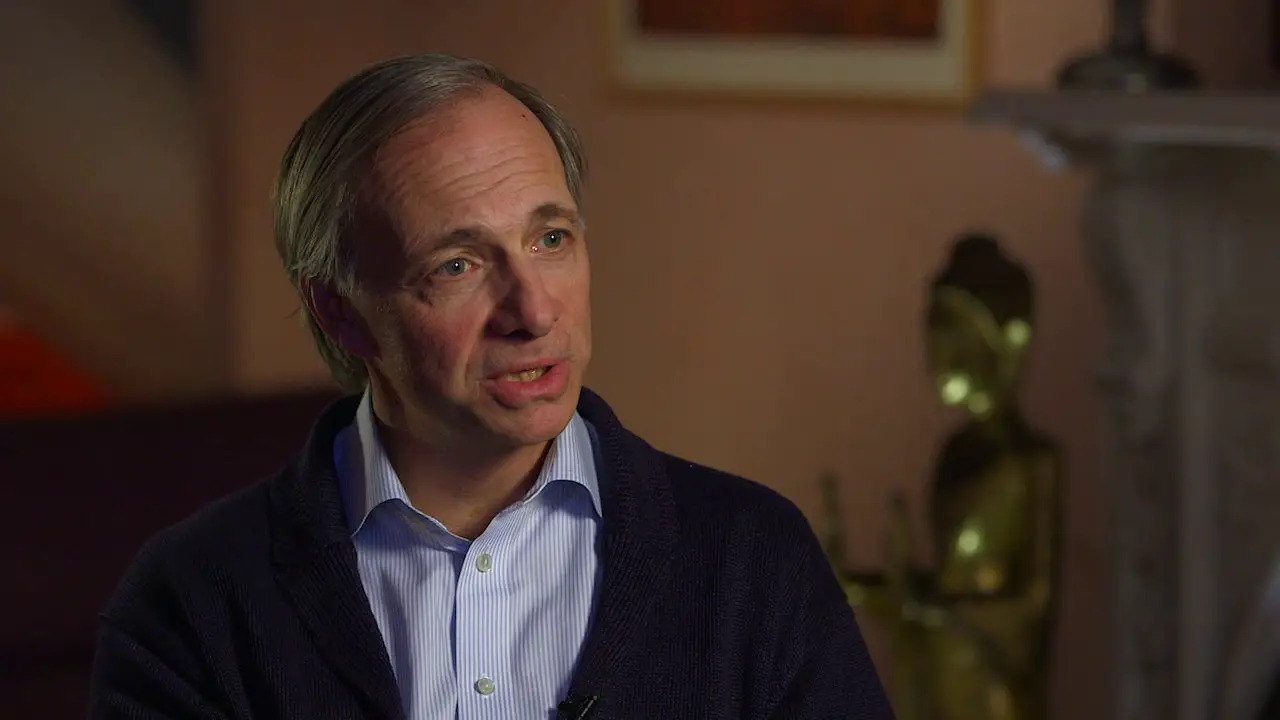
This is a transcript from an interview between Ray Dalio, founder and co-chief investment officer of Bridgewater Associates, L.P. and Laurence Freeman OSB recorded in 2013.
Laurence: So Ray, you’ve been meditating for a long time. How long have you been meditating for?
Ray: 42 years.
Laurence: And what got you started?
Ray: When the Beatles started meditating and they drew attention to it and it was a curiosity and I thought I would try it and then it’s changed my life. It’s the biggest influence in whatever success I’ve had in life.
Laurence: So, can you remember what it was like in the first few weeks or the first few months?
Ray: Yeah, I remember wrestling around with it. I remember that as you go into the mantra and the thoughts would come back and it would be that back and forth and then as it got better and better and I got deeper into it, the thoughts would become more valuable, more tantalizing and it was almost more of a temptation to think about those particular thoughts because I didn’t wanna lose those ideas and then I knew that I had to push those away and it was almost difficult and then after a while I remember then disappearing into it and that was something.
Laurence : And what were the first, benefits that you found in the practice as the habit grew as it became part of your life?
Ray: Well, the first the first benefits were that ability to that quietness, the tranquility, the ability to get energy from it rather than sleep, it would provide me more energy than sleeping, those kinds of benefits but then it went on, to develop an ongoing equanimity that centeredness, that ability to go above myself and my circumstances and to look down at them from a higher level with a clarity and an objectivity and then it started to bring out my subconscious and my creativity, because subsequently I’ve studied neuroscience, I’ve been very interested in that. And I’ve learned that there’s a part of our brain in the neocortex which is where imagination exists, which is where creativity exists and it opened me to that. I experienced it. I didn’t understand what was happening at the time, but it provided those things as time went on.
Laurence: Where did the understanding of, you might say, the discipline of the mantra come from? Because, you realized during the meditation you were having great ideas and imagination and creativity but you also knew that you had to let go of those ideas at the time of the meditation and keep going back to the mantra. Was that a natural instinct?
Ray: The natural instinct was to go to the ideas, but I also, combination of a teacher and the realization that as I would go deeper I was gonna get more, encouraged me to go deeper and it’s not easy to throw away those good ideas.
Laurence: You told me once that your interest in investment wasn’t just to make money it was also the fascination of the the game. How did that happen?
Ray: Well, when I started when I was caddying and I earned, you know, $6 a bag. I’d go around and I have my $12 and so two things were happening simultaneously, at that time, I was interested in making some money with that originally, but also the game of it caught me, so I got very enthralled by the game of it. Money, vast amounts of money was never a major major objective of mine even early on it was the game of it that hooked me.
Laurence: So, you wouldn’t say you were caught up in any way in the culture of greed that we see around?
Ray: No, no it was my, it’s never been. I’m a very simple person. So no, it’s never been anything like greed. I think greed is unhealthy.
Laurence: How has the meditation helped you stay detached from the money and from all that came with it?
Ray: Well, first of all, let’s be clear money has no purpose other than there’s something for it, so the question is what are the things you’re going after in life? Bigger car, bigger house, these are not the most important things for me, but in any case what meditation has done all for me is to be able to help me step back and see things at a higher level. But when we talk about spirituality, spirituality to me is the ascending to a level where you feel connected to the whole and you realize you’re part of that whole and literally brain science, neuroscience has shown how that comes because if you take brain imaging through meditation that they show that the prefrontal cortex, the part of the brain that really almost really defines man lights up and the part of the brain which is the animal part of the brain that produces these fight-or-flight reactions and that anxiety, the amygdala calms down and so physiologically the brain changes as a result of that meditation and the result of that as we’re evolving, as brains evolve, is to bring us above that and to create creates a connection.
Laurence: OK, so that’s the science, and we know that meditation isn’t just theoretical, it is biologically and neurologically grounded and can be described in those terms to some degree. What’s the actual expression of that in terms of life, relationships, decisions, work – you say that this meditation gives you this higher perspective, this higher level of detachment and so on. At that higher level when we all go up and down maybe on it, where you see things from that perspective, what are the essential values of life?
Ray: My own essential values is personally to evolve, and I think it’s the nature of the universe that the most powerful thing in the universe is the only thing that lasts is evolution and for me it’s to evolve in my learning, in my getting a higher level of perspective. It comes to having almost a sense of a greater understanding of the universe and then a greater appreciation of my connection with the universe so I feel very connected in that way with people and beyond people, with nature, that wholeness. People are one of 30 million species and there’s the whole connection to that whole thing.
Laurence: When you find yourself under stress and anxiety, things go wrong, you get disappointments things don’t work out as you hoped, you must feel a moment of anxiety, a moment of stress. How do you deal with that, what happens?.
Ray: I can go out of the stress I can at any moment. There are times when I feel the stress of the circumstances, and then I can at will go out of that stress. And just see things, in a different way and it makes me feel almost like a ninja, everything seems to come in slow motion and in the sense you could step back and it’s coming at me at slow motion and I can deal with it in a way that makes me feel more centered and in control.
Laurence: Like tennis players they say at the height of their game, the ball seems to go much slower, the whole game slows down.
Ray: That equanimity that produces that kind of a reaction as distinct from when you have the anxiety, there’s not the clarity, it’s all coming too fast.
Laurence: OK, so let’s just take a scenario. You’re in your office and you’ve had made some decisions and then those decisions you have to revisit them because if something has happened or the markets have changed or advice has changed, and then, you feel disappointment or stress or anger or irritation about something. Where does the meditation affect you, at the same time or is it later in the day?
Ray: No, no, for me the way it’s changed my perspective. So in other words, I don’t view it. Bad things are going to happen to me. I just view it as things happen. And so I view reality almost like a machine, in which one thing happens after another and I accept reality. I think reality is beautiful even though it’s challenging. So, when I look at it, it’s almost like everything is another one of those. I put it in perspective and the same things happen over and over and over again and so by sitting back and seeing it’s another one of those or why is it. For me now it’s become in the middle of simultaneously, right, simultaneously in the middle of the anxiety., and it’s taken me a long time to get there, but by and large, as it’s coming, whatever the circumstances are, I’m so close to that.
Sometimes I’ll feel, you know that twinge of anxiety, but I can bring myself into the position and I say, OK, let me step back and say how does the world work? These things will happen. It’s just the way reality works. It’s an acceptance of reality and I think it’s almost an acceptance of reality works in a beautiful way, and I have to just operate in harmony with that reality so it’s my responsibility to be calm and to operate in harmony with that reality whatever that reality is.
Laurence: you’re also a leader, so you have to deal with people sometimes they disappoint you, sometimes you have you recruit them you have to let them go perhaps sometimes, you have to deal with teams and the relationships between the individual members of the teams. How does meditation help you as a leader?
Ray: Well, I think you also in order to answer that question you have to understand that what the principles are that we’re operating by because it’s a lot consistent with that way of being so it’s an idea of meritocracy in which everybody has the right to make sense of things and that there can be thoughtful disagreement.
Yet thoughtful disagreement, I believe is the most powerful force to being right. So the markets are zero sum, so we can’t have a consensus point of view and make money because the consensus point of view is already in the markets and so we have to have a different point of view and when there’s a different point of view, you’re never sure whether you’re right or wrong and so if you have a point of view that’s different from everybody else, there’s a good chance you can be wrong. And by being able to have that thoughtful disagreement in which everybody can be very natural and approach that and have that respect without tripping over the ego parts of it is extremely powerful. To be able to deal with weaknesses and mistakes we all have we all make mistakes, we all have weaknesses and what happens in most people is that they they have an anxiety reaction to the mistakes.
Laurence: Are you, are you a a nice boss?
Ray: I think most of the people would consider me to be like a really strong parent who loves their kids a lot. I love the people that I’m working with a lot and at the same time that we have to set high standards for each other in a non-hierarchical way and so we’re operating by those very high standards that we feel are healthy with each other so to hold each other to that high standard we believe is really good with each other. They would think that I’m nice but don’t construe that as nice being soft.
Laurence: So, you’ve had you’re you’re in the height of a successful career you’re obviously looking to the future. How does meditation give you a sense of perspective in terms of the stages of your own career and your own life?
Ray: So I see myself within the cycle of life and I’m now in a stage of my life in terms of that it’s my responsibility to transition to teach. In other words, there’s a various stages in your lives. I think of it there are three stages. The first stage is you’re dependent on others and you’re learning. Then the second stage, others are dependent on you your kids are dependent on you, and you’re working and that’s a stage where you accomplish and you conquer and achieve and you do the best that you can. And now I’m in a 3rd stage of my life which is to transition and to teach and to share that and go. In my natural course of things that’s how I, I view it and that’s how I view it.
Laurence: What advice would you give to to young people? I’m thinking of some MBA students that I’m teaching at the moment, how would you advise them? They’re at a time in their life where they have great concern about their future career, the decisions they make. How does meditation going to help them? Would you advise them to meditate?
Ray: Well, first of all, I wanna say that the most important thing I could tell them is I have a saying that ‘pain plus reflection equals progress’ And what I mean by that is if every time they take a pain that will be they’re experiencing that pain that’s an amygdala emotional reaction if they can then come out of that pain and then look at it objectively, what is it? Pain is a signaling device and so if you can look at that, there’s a lesson because you can do something, because another one of those is gonna come along many times in your life and if you can come out of that one painful experience and learn a lesson that’ll help you in the next time that will be terrific and what happens in meditation there are two things I’d say pertaining to meditation meditation will help to reduce the pain of that moment and help to increase the reflection. The other thing about it is I think that most people think that the way that they’re going to make the most progress is in their conscious mind. In other words, put as much into your conscious mind as possible and have your conscious mind work as hard as it possibly can in order to achieve the goal and that’ll be effective. And they don’t know the path of going into the nothingness, the void, and what’s coming inside because when you go inside and you relieve that and you’re also letting this subconscious creativity, imagination, all of those other elements come out and through meditation you’re going to begin to experience these ideas coming out, this creativity coming out this type of thing that doesn’t happen because you’re working hard. The great ideas, the creativity come like from being relaxed during in a hot shower and all of a sudden it comes to you and you have to grab it because it’ll pass you by. It’s not because you’re working at it and so to allow yourself the 20 minutes twice a day. To allow yourself that is going to be to release that creativity as well as to get you centered and it’s gonna have such a payoff in terms of thinking strategically and going above it and it’s not in just grinding it out harder.